Thursday
If
there were not a seasonal job that took precedence, Thursday morning
and on into the afternoon, until it was time to go out, was given
to sewing. It was ladies' work compared to the work of Monday
and Tuesday. Before they settled down, clean aprons were found
and hair freshly combed. Already the usual, regular, morning work
had been done, the making and cleaning up from breakfast, the
feeding of the animals and the milking of the cow. Mama had probably
taken time to call Aunt Lillie and Grandma. They talked every
day.
Sewing
could be as utilitarian as making towels or as special as a silk
dress. All towels were coarse cotton, hemmed. If they were dishtowels,
the two narrow edges were bound with printed cotton left from
making someone's dress. Cloths for spreading over the top of food
left on the table from Sunday dinner for Sunday night's supper
were lighter weight, probably well-worn tablecloths, cut down
and hemmed. Damask tablecloths were sometimes bought unhemmed
and then hemmed.
When
an apron had to be cut out, the well-worn pattern came out of
the wardrobe. The pattern, the cloth and scissors were taken into
the dining room where the apron was cut on the dining room table.
Knives and forks were laid on the smoothed out tissue, the pattern
pieces laid and re-laid so that the apron could be cut from the
minimum amount of yardage that had been bought. Material for dresses
was similarly cut. Mama pinned and basted the pieces together;
Aunt Merica did most of the machine sewing. Things did and didn't
fit; long seams of tiny machine stitches were picked out; darts
were taken and released. The presser foot was replaced with appropriate
size hemmer foots to quickly turn under and stitch hems. My favorite
was the tiny, tiny hemmer. It was used to hem yards of narrow
material which, when the ruffler foot was put on and the strip
fed through under its tongue, turned ordinary cloth into beautiful
ruffle trim. Finally, an acceptable garment emerged.
Miss
Irene, the community seamstress, came if there was lots of sewing
to do. She came, years later, to make my trousseau. Dresses and
altered coats flew out from under the machine. When she came,
Mama always had a company dinner. A chicken would be killed the
day before and while we sewed, it cooked on the kitchen stove.
Then Aunt Merica would make dumplings
and we would have three or four vegetables along with hot bread
and dessert. Sometimes Daddy was home.
Afternoon
sewing in August was made more pleasant by moving the machine
out onto the front porch or into the back hall. By leaving the
hall door open plenty of light poured in but best of all was the
cool breeze that came through from the west. Here Aunt Merica
made the blue and white checked cotton dress for my doll, Nancy
Jane, using scraps from one of the three checked cotton dresses
she had just made for me to start school in town. I folded these
lavender, green and blue dresses and put them in the buttermilk
blue chest, passed on to me by Aunt Merica for my clothes. It
was here in the back hall that Aunt Merica made a dress for the
girl who lived in the tenant house on the other side of the garden
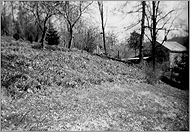
and one for the little Gypsy girl who lived in a tent below our
house near the spring. Every summer the gypsies came. None of
our chickens were stolen. None of the tools in the shed disappeared.
All of us neighbors bought the beautiful baskets they made.
Sewing
continued into Friday if there were no seasonal jobs and no company
was coming on Saturday or Sunday. Otherwise, Friday had its duties.
Sewing on Friday ended sharply at five o'clock. Ended until next
Thursday, no matter how badly I wanted my dress to be finished.
There was a lot of waiting. Aunt Merica might remind me that at
least I didn't have to weave the cloth as she had had to as a
young girl. Nor grow flax nor spin as she and her Mother had done.
Nor did I, I thought, have any place to tack up poems. Aunt Merica
said she tacked them on the big loom and memorized them as she
wove.
The
depression ate into us gradually. Easter outfits that would have
been bought without forethought, now caused Mama to hesitate.
Material at ten cents per yard in the mail order catalogues had
to be studied over, material for only one or two dresses ordered.
The coarser feed sack material began to be used, a hard decision
for Mother to agree to, but finally acceptable when all the neighbors
started using it. Grandma bought spring coats for my cousin and
me.
Early
in the morning I would lie in bed and listen to the conversations
in the kitchen. After Aunt Merica went out to milk the cow, Mama
and Daddy would begin to talk about the family's needs. Sometimes
I would hear Mama crying. Sometimes she would say, “But,
Henry, they just have to have shoes.”
The
depression deepened. Daddy's work was sporadic. His wages dropped
and dropped. Finally, he said, “I refuse to work for less
than three dollars a day.” He kept searching for work.
I
kept growing out of clothes. Aunt Merica took her good wool dress,
dyed it and some cotton sheeting a nice green to make a jumper
and blouse for me. They took another beige garment and some softer
matching cloth to make a skirt and blouse. Two outfits for one
year at school. It wasn't long before I discovered mix and match
and had four outfits. Quietly, they began work on a coat for me.
Mama gave her once new, beautiful fur-trimmed coat that she and
Daddy had bought in Roanoke. It was made into a plain, beige coat
for me. After that, all winter, Mama stayed home to cook dinner
to have ready for us when we came home from church. Daddy went
alone to the winter school functions, wearing the same blue suit
Mama cleaned and pressed each Saturday.