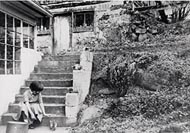
Monday
All spring, summer and fall, every Monday morning,
the big gray zinc washtubs were taken off their nails on the wall
of the first room in the shed and brought down to the back porch
where they were put on straight back chairs and filled with hot
water from the black iron kettle sitting in its three legged stand
over a fire of fallen tree limbs. Aunt Merica had dragged these
branches in from the woods one afternoon the weeks before and
now had them piled under the kettle here outside the kitchen door
on the little rise between the white lilac and the snowball bushes.
Sometimes this black kettle sat over its fire up above, beside
the walnut tree stump. When not in use, it was kept in the shed.
The weekly wash was gathered from the bedrooms,
brought to the open, concrete floored, back porch, and sorted.
One, maybe two overall, a work shirt, a Sunday shirt, one set
of underwear, socks both work and Sunday. Mama's work dress, some
aprons, her one set of underwear. Aunt Merica's. Joe's. Mine,
which might include more than one school dress and play clothes.
Bottom sheet from each of our beds. Pillowcases. Towels. All heavy
cotton. All to do by hand. No wonder I had to take off my Sunday
dress as soon as I got home from church, had to change to play
clothes on arrival from school, had to take care.
The wash tub was filled with hot water, the two
rinse tubs with hot or cold. The washboard, which like the tubs,
hung in the shed, went into the first tub. A cake of homemade
lye soap came from the supply drying in the junk room of the shed
or from the bottom shelf of the washpans' table. Here, under the
washpans, was a bottle of bluing, which went into the last rinse.
Aunt Merica started the fire under the kettle when she got up
to build the fire in the kitchen stove. If the kettle had not
been filled from the cistern the night before, she filled it.
Then she went to milk the cow and Mama made breakfast.
It was not a bad arrangement. The tubs on the
back porch were outdoors, but sheltered. Tucked under the roof
with the house wall on one side, the kitchen wall on the second,
the stone wall two thirds way up on the third, even raw winds
had a hard time finding their way in. Temperatures, so early in
the morning, were generally even a bit chilly on the hottest days.
Water was close in the cistern; heat and clotheslines were nearby.
Best of all, slopped-over water didn't matter. If it were spilled
carrying it from the big kettle to the tubs, the yard didn't care.
If it were sloshed over from the tubs or dripped between the suds
and the rinse, the water ran off the floor onto the ground where
rain dripping from the roof had beaten out a bed of pebbles. Rain
or wash water falling here ran off into the grass. And, anyway,
when the wash was finished, one tub would be dumped on the floor
and the whole porch swept clean with a broom.
The wash tubs sat on chairs, brought out from the kitchen. Sometimes
the stained, dark red bench, which was Joe and my seat at the
table, was carried out but it was a bit narrow to give a firm
base. The wash board, with its cake of homemade lye soap sliding
around in the cavity at the top, stood in the first tub, water
steaming. White clothes went in first: Daddy's Sunday shirt, Joe's,
the bottom sheets, dish towels. Before these white clothes were
put through the two rinse tubs, they were carried out to the black
iron kettle and boiled. Often I got to stir the clothes with the
washpole, its end cooked white from many uses. I liked to lift
the clothes and watch the steam rise, hear the splash of water
back into the kettle, smell the strong wash soap and the wood
fire underneath.
The final rinse tub held the blueing water, necessary
to keep the white clothes even the boiled white clothes, from
looking yellow. Finally, there was the pan of starch which Mama
or Aunt Merica had made earlier that morning, stirring flour into
cold water then bring it to a boil on the stove while repeatedly
stirring. Afterwards, when the starch had cooled somewhat, it
was poured into a cloth, which had been draped over the dishpan.
I found it rather tricky to pour the starch, get rid of the hot
pan, gather up the corners of the cloth and get started on twisting
the cloth to extract as much starch as possible, before one of
the corners sank into the thick, white, hot mass. Then, once the
twisting got under way, me holding the top corners with one hand
and the hot ball of rejected lumps in the other, turning one hand
one way and the other hand oppositely, the starch oozing out between
my fingers, slick and satiny, I knew my hot job was nearly done.
Aunt Merica decided if it was right, or too thick, and how much
bluing to add. It had to be thick for Daddy's collars and cuffs,
thinner for pillowcases and tablecloths, aprons and dresses. Finally
the overalls got dipped.
Buckets of scrubbed, rinsed and wrung-out clothes
were carried out to the wire clothes line which was fastened at
one end to the tall walnut tree stump, held up at two points by
forked poles, and fastened at the other end to the big cherry
tree. A second line ran between the two cherry trees. Later lines
ran out in the yard under the apple trees but early on the trees
were small and corn grew through there, down over the future rock
garden and on down to the road. The wash was hung piece to next
piece and fastened together with one clothespin. There were often
more clothes than clothespins, more clothes than lines, especially
when the black heart cherries were ripe, and clothes could not
be hung under the trees. Then the colored garments were spread
upon the grass and carefully shaken to remove ants when they were
dry. I liked to play with the two-legged pins; they made men to
go with my dolls. The other ones bit.
By ten, rarely as late as eleven, the wash was on the line and
the day's work done. Never mind that there was dinner to cook
and supper to fix and for each the vegetables had to be picked
from the garden, fires made each time in the cook stove, table
set, dishes washed, kitchen swept and later, when the clothes
dried, clothes brought in and sprinkled for the next day’s
ironing.
In winter, things changed. Then the usual pattern for washing
clothes was abandoned and the kitchen was transformed into wet,
chilling chaos.
The kitchen was normally a warm and friendly place, filled with
the soft noises of people making things, of pots simmering on
the stove, of the kitchen screen slamming shut after its last
opening. It was one of my most favorite places to be. Except on
Monday morning, in the winter.
On these winter Mondays vats of water were put
on the cookstove as soon as breakfast was over. They sung away,
beginning to steam up the kitchen, while the dishes were washed.
Then, no matter how cold the weather outside, the kitchen door
was opened. Into the kitchen came the washtubs. In came the soap
and scrub board. In came the bluing. Out went the buckets of clothes,
even through the snow, to be hung on the line. The sheets froze
stiff. The underwear froze stiff. The overall froze stiff. We
all nearly froze stiff. Only on the rare days when we had sleet
on Monday were the clothes hung inside. Then great cord lines
went back and forth across the bedrooms, the buckets of clothes
were carried upstairs, and clothes slowly dried, filling the air
with their clean, wet odor.
Aunt Lillie had a washhouse, outside the yard,
between the calamus-filled swampy land beside the branch and the
picket fence along the front side of the yard. It was a one room
dirt floor house with wash tubs sitting around an their stools
and a flat topped, black bellied stove in the corner for heating
water. The floor was not hard like our cellar. Our cellar was
almost like concrete. One or twice each year the room was swept
and Daddy or Aunt Merica sprinkled lime on it to make it hard
and sweet. This wash room was always dark and rather scary and
so we never use it for hide and seek.
You could always tell from our house if Aunt
Lillie was washing for great plumes of white smoke curled up from
the washhouse chimney. Later on you could see clothes hanging
out on the line and draped over the fence if she had a lot to
wash that week. This is when Mama would call if she didn't see
the wash.
It was a Monday morning, some time in the winter,
when Mama, talking to Aunt Lillie, listened to something Aunt
Lillie said and then Mama laughed and laughed. Mama said something
about Mrs. TomP and right away I knew what was funny. It had happened
on Sunday morning, the previous day.
Mama had worn her new, beautiful coat, the one
she and Daddy bought in Roanoke, with the fur collar and the swinging,
fur-trimmed panel. As we went into church, you could feel all
the neighbors seeing her coat. We sat down in our places. And
soon Mr. TomP and Mrs. TomP came in, and do you know, she had
on a coat just like Mama! Well, things got pretty tense. Daddy
said something to Mama and Mama just sat there. A few people squirmed.
Mrs. TomP sat down; then she got up, and she took off her coat
and folded it up and sat on it.
That morning as I lay in bed, after Aunt Merica
went down to make the fire and Mama went down to get breakfast,
I could hear Mama and Aunt Merica in the kitchen, laughing, wondering
when Mrs. TomP would get up off her coat. Aunt Lillie must have
wondered, too.
Improvements came to us in the form of a clumsy-looking
wooden washing machine, which was turned by hand. Its home was
inside the cellar, behind the door, where it sat on the hard dirt
floor all week, hiding in its insides the cheese Mother bought
for Joe's school lunches and which after school he searched for,
neither of them admitting to the other that the hide-and-seek
was on. On Mondays it was dragged out into the flat space in front
of the cellar door, there where Aunt Merica sat to churn beside
the milk bench; where, in fall, jugs of apple juice were lined
up on top of the stone wall of the kitchen porch, the jugs with
their corks askew so the vinegar that would make inside would
not break the jug. The washer was a help and not a help. Water
had to be carried up the steps to fill it and the rinse tubs perched
on chairs outside the cellar. Dirty clothes had to be carried
up. The black iron wash kettle was moved from the yard out in
front of the kitchen door to a flattened place beside the path
by the walnut stump, making it a short distance down the path
from the washing machine to the kettle and back to the rinse tubs.
The soapy wash and the rinse water could be drained off to the
flowerbeds or the garden.
After the War and after water was put in the
house, the new automatic washer took up residence on the now enclosed
back parch. White clothes were no longer boiled and lye soap was
made no more.