Saturday
The
week's work was drawing to a close. The cooking for Sunday that
remained to be done, the chickens that needed to be killed and
cut up, the last minute tiding of the house and the sweeping of
the porches, were jobs that had to be done on Saturday morning,
but there was a sense of work coming to completion. The week was
ending. Tomorrow was Sunday.
Right
after the breakfast things were cleared away and Daddy went to
work for the morning or he went outside to do some work at the
shed or the barn or the garden. Aunt Merica put on a pot of potatoes
to boil, and a pot of water for Mama to use to scald the chicken.
She set a pan of milk on the back of the stove to heat, slowly
and form curds for cottage cheese.
While
she did these things and got ready to make pie dough, Mama would
get Daddy's Sunday shoes polished and his Sunday suit pressed.
If a spot showed up, she left her work, found Daddy where ever
he was and sent him to the car to get a bit of gasoline. The open
cup of gasoline sat on the table beside the hot iron as long as
Mama needed it to sponge out spots. Likewise an open can of corncobs
soaking in their bath of lamp oil sat on the floor between the
wood box and the stove. Aunt Merica kept it filled and everybody
used the cobs to start fires. Nothing worked better than an oil-soaked
cob. Except perhaps, a splash of oil.
When
Daddy's clothes were ready for Sunday and hung away, Mama went
to kill the chickens. One or more had been penned up when the
rest of the flock had been let out of the chicken house that morning.
Holding
the chicken by its two legs, Mama carried it out to the edge of
the orchard, spread its neck over a stump and with the hatchet
that was always kept in this chicken house, whacked off its head.
She flung the body out into the orchard so the gush of blood would
not get on her clothes and while it flopped around for awhile,
she put away the hatchet and retrieved the head. She laid the
chicken down where the cats would not get it and went into the
house to get the kettle of water that had been left to boil on
the kitchen stove. Out by the lilac tree, the brass kettle was
placed securely in the grass and by holding on to the legs of
the chicken, she quickly dipped it up and down enough to loosen
the feathers, not enough to set them. Tough wing feathers might
get an extra dip. Dipping the head was a problem. The breast feathers
were plucked onto a paper and later taken to the shed to save
to make feather beds or pillows. Tough feathers were discarded.
The
chicken was washed, sometimes with soda, rinsed, and cut up. When
the gizzard was cut open, I liked to look at and feel the bright
bits of stone the chicken had picked up. If I were cutting up
the chicken, I did not like to make a mistake and nick the craw.
Then all its recently eaten food spilled out. But that was better
than slicing into the ropey intestines.
Once cut up
and rinsed the chicken was put in a crock of salt water and taken
to the cellar to stay cool until needed on Sunday. If we were
having company, there might be several crocks of chicken.
While all
this was being done, Aunt Merica made the smierkase. She poured
the warm milk that had been sitting on the back of the stove for
some hours through cheese cloth, gathered up the four corners
and twisted the bundle to remove as much whey as possible from
the cheese before hanging it to drip in the cellar.
Pots containing
food for dinner and potatoes for salad were simmering and steaming
on the stove. As soon as the potatoes stuck done she skinned and
broke them into chunks with two forks. Hard boiled eggs, fresh
out of their hot water, were shelled, chopped, and added. Pickles
from a jar from the cellar and maybe a bit of chopped onion went
in as did salt and celery seed. Over it, Aunt Merica poured a
dressing she had made.
Finally the
kitchen got mopped. Everything, including food for dinner, was
ready by twelve o’clock when dinner was served. From the
side table in the dining room some food would be taken to eat,
other left untouched until Sunday.
Saturday
afternoon
After
dinner, Daddy shaved, took a bath, and went to town. While he
was getting ready, Aunt Merica fixed a basket of eggs for him
to take to sell to the grocery store. All the eggs left in the
box were put in the basket. Those gathered Saturday evening would
begin supplying the family for the coming week. Cream and butter
that could be spared were made ready to send to the same grocery
store or the creamery. In season, excess vegetables might be made
ready to take. It was excess that was sold: nothing had been produced
far sale. My father was a builder, not a farmer.
Mama
made out the grocery list and got ready a scrap of goods for him
to use to match thread at Gammons. Or some times she just wrote
down "white 60" or "black 40". The grocery
list was short but contained the few foods we could not supply
for ourselves: sugar, Jello, rice, rat cheese, macaroni, flour
and meal.
Daddy liked
to go to town to talk to people and maybe even see somebody who
wanted a house built. Or maybe he would find somebody to hire
to do some special help with next week's building. Mama and Aunt
Merica might go sometimes, if Daddy wasn't going to stay too long.
Instead, after
we got cleaned up, we sat out on the front porch and watched our
neighbors and friends go to town. Some went in wagons or buggies.
One farmer had a two-seat Ford. Many farmers had model T’s.
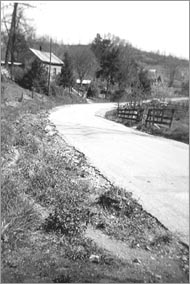
We watch them go to town from up towards Fairview and Cedar Springs.
Then, several hours later we could watch them come back. We could
watch people come out of the Glade and down the road from Aunt
Lillie’s. We sat behind the screen of cinnamon potato vines
that Aunt Merica made each spring by training the plants up binder
twine fastened to stobs in the ground and nails on the inside
of the porch ceiling. This gave us a cool, private shelter. Aunt
Merica knitted and Mama crocheted or did drawn work.
Daddy
returned. The hundred pound sack of sugar was put into the corner
of the kitchen, there beside the fancy oil stove that was used
for cooking in summer when it was not necessary to heat up the
iron stove. The hundred pound sack of flour was emptied into the
flour chest. The twenty-five pound sack of cornmeal was emptied
into the meal chest, the second compartment in the flour chest.
The jello, the macaroni, and the rice got put in the blue painted,
punched-tin fronted safe in the dining room. The cheese got hid
in the washing machine in the cellar.
After
supper, in summer, we sat on the porch and watched the lightening
bugs. Or played with some of the beetles that came out to crawl
around. Or held on to snapping bugs, just to hear them snap. We
were country, but inside the house there was never a roach and
only after water was put in did we ever have ants, and that rarely.
The nights ware dark; the sky full of stars. The Milky Way was
visible. Around the moon there sometimes appeared a soft white
ring.