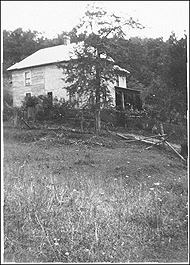
The Day
“I
will be a nurse or I will get married.” Thus my mother defined
her future. The gauntlet had been thrown down.
For my Grandfather, the choice was easy: she would not go out
of the home to work as a nurse. For my mother, later, there were
wistful thoughts of what might have been and a determination that
I, her only daughter, should “make something of myself”
and escape the “drudgery of housework.” But, never
was there any thought of change or moaning about what might have
been. Once she made the choice of marriage and family, then that
became her profession for life, just as surely as building houses
was my father's profession. He was a carpenter. She was, in cooperation
with my aunt, the provider of food, the overseer of clothing,
the controller of the home. In later years, when I had grown up,
when I had graduated from high school and college and had my share
of exposure to culture, I once said to Mother, “Why don't
YOU read books?” She paused in her descent down the steps
from the cellar under the old house to the kitchen porch of the
new house to which she had come, fixed me with her dark eyes and
said in the sharp tone she so rarely used: “You have your
life and I have mine.” Period.
She came to the almost-new house my father had built, a young
girl of lineage known by oral history to go back four generations
to New Jersey and proved later to be the English of Penn's Quakers.
She joined a family long having forgotten their roots in the highly
skilled craftsmen of the 18th century German immigrants to Pennsylvania.
Both families were now and had been for some generations, American.
While my father and his sister made reference on occasion to “the
old country,” there was no knowledge of their origin. Never
was there reference, and I would say, any knowledge, that the
roots of these two families, my mother's and my father's, had
come from the two great waves of people who settled Pennsylvania
in the 1700's: the Quakers and the Germans.
Yet
as I grew up, I sensed a difference. I could not define what or
why. It was as if they came with two different viewpoints: mother
bent more on education, more sensitive to “what the neighbor's
will think,” my father's family with more emphasis on work
and freer of worry about opinion. I attributed it to female and
male. Yet it did seem cultural. Could enough 18th century traits
still linger to define my parents as products of their origins?
My
mother came as bride, but not as top dog housewife. My father's
oldest sister lived there, as did two other sisters. In due time
one of the sisters married and one went to live elsewhere, but
the oldest sister, the one who had raised my father and served
as mother to her ten younger brothers and sisters when the mother
died, remained.
The
neighbor's homes were much like mine, some with a grandfather,
old uncle or aunt, sometimes a younger brother or sister waiting
to marry or, due to physical or mental enfeeblement, accepting
a home. The additional food and clothing care was taken for granted,
as was the help with work around the house and fields. The orderliness
of the running of my home had been sorted out by the time I was
conscious of observing such things, but ever there lingered the
sense that Aunt Merica's opinions held sway.
Early
Morning
It
was she who got up first every morning and made the fire in the
kitchen stove. I, who shared her room, was left to sleep, but
often I would hear my mother leave her bedroom and go down next.
Then the conversation started. It was a mixture of plans for that
day's work and references to neighbor problems and happenings.
If my ears were sharp, I learned more then than they expected.
Soon
there was the bang of the back porch screen door, the end of conversation,
and the low movements in the kitchen beneath me. Aunt Merica had
gone to milk the cow and feed the chickens. By the time she came
back, collected hot water to wash and scald the crocks and strain
the milk, my Mother would have started the coffee perking, put
side meat on to fry, mixed and cut out the biscuits and set the
oilcloth covered table. Aunt Merica came in with butter and cream
from the cellar. Mother broke some eggs in the meat skillet then
opened the kitchen door into the hall and called upstairs to Daddy
that it was time to get up. She then turned her attention to packing
my father's dinner bucket.
Coffee
went into the thermos with bit of cream and was fastened with
the long metal tongue into the top of the pail. She filled the
capped glass jar with jelly, jam, or marmalade. Biscuits were
filled with ham, shoulder meat sausage or eggs and extra biscuits
put in for the jelly. A spoon went in, ("How was your day,
Henry?" "Well," he said in a kindly way, "there
wasn't any spoon for my jam" Or maybe she would say, "I
forgot to put the spoon in today, Henry. How did you manage?"
Mark up one housewife failure for that day). Some fruit got tucked
in: grapes or apple, pear or plum. Pie or cake, wrapped in wax
paper got added last, to sit on top and not get mashed. The pail
was closed and about that time my father appeared, ready to eat,
then take his lunch and head out to the house he was building
in the town two miles away, to roof the silo on some neighbor's
farm, to the schoolhouse being built in the east end of the county.
The rush of morning duties ended with my father going out the
back hall door and backing the car down the hill to the road.
The rush ended but not the work.
Breakfast
dishes and the utensils used far its preparation were washed in
a dishpan filled with hot water from the tank attached to the
big, beautiful iron cook stove, perhaps heated a bit hotter with
boiling water from the black iron tea kettle. Aunt Merica washed
and Mama dried. While Aunt Merica washed out the dishtowels, Mama
put away the dishes in the punched tin fronted safe, the utensils
in the big oak kitchen cabinet. Then the water tank was filled
from the cistern on the back porch, the hogs were slopped, and
attention turned to the work of the day.
Morning
Days
had specific morning tasks. At my home and at the surrounding
farm homes, Monday morning was for washing. If my aunt's wash
was not on the line by the expected time, my mother wiped her
red, water wrinkled hands, turned the telephone crank the appropriate
longs and shorts and asked if she were sick. Clothes were sprinkled
Monday night for ironing Tuesday morning and then mended on Wednesday.
Washing took all of Monday morning, but on other days there often
remained enough time to do a small job before going out to pick
vegetables or, in winter, up to the cellar to bring down jars
of canned vegetables and fruit and start cooking dinner.
Noonday
Dinner
was the meal in the middle of the day. It was always hot, sometimes
with meat, always vegetables, freshly baked bread, and desert.
Bread was light bread or rolls but seldom biscuits and not cornbread.
Aunt Merica generally started the light bread after supper, and
let it rise over night. Next morning, three or four loaves were
made out, allowed to rise and baked in the oven which would certainly
be hot and ready on Tuesday morning when irons were heated on
the top of the stove. Rolls were placed close together in a small
square pan, so that when baked, only the tops and bottoms were
brown. We might eat some leftovers, but if my father was not carrying
his dinner and was coming home, everything was freshly prepared.
Sometimes instead of carrying dinner he was invited to eat with
the family he worked for ("Mr. Henry will stay for dinner").
The
morning dishwashing was repeated. Milk, cream, and butter were
returned to the cellar. Of the food, only a few things were kept.
We were not a family that ate many leftovers. Fried chicken and
other meats, mashed potatoes (to make potato cakes for the next
day) or boiled potatoes to be fried the next night, food far inferior
to freshly fried potatoes I felt, green and shell beans along
with the jelly and marmelade, pickles and jams went into the tin
fronted safe. Biscuits, light bread, and rolls went in the safe,
too, put on the old white platter on the right hand side of the
middle shelf.
Cornbread
and leftover biscuits were never served again, but the biscuits
were kept in case my brother got hungry before the next meal and
needed an apple butter biscuit. Fried potatoes, corn on the cob,
tomatoes, everything else went into the slop bucket for the pigs.
This sounds terribly wasteful but for two reasons it was not.
One, there was never much left. Two, it went for a good cause:
fattening the pigs.
Early
Afternoon
Then
my mother would say, "I'm going to lay down a bit before
we start" whatever seasonally appropriate work needed to
be done. If there was no pressing work, and if it were summer,
she would spend the afternoon crocheting or embroidering while
Aunt Merica knitted. If it was winter, they probably worked on
quilts. Sometimes they would see a neighbor some distance off,
walking under an umbrella on a sunny day, no doubt coming to our
house to visit. Then there would be a flurry of being sure the
porch was swept or the house was straight and their aprons changed
to ones freshly washed and ironed.
Afternoon
Visits
with or from neighbors seldom fell on Monday or even Tuesday,
for everyone was too tired. But, Wednesday, Thursday, and Friday
might bring my aunt or a neighbor for a several hours' visit,
sitting out on the front porch in warm weather, in the warm kitchen
or living room in winter. Now I wish I could recall the conversations,
but at the time it bored me dreadfully. Women's talk. How the
garden was growing, what had been planted, how much they had canned,
were the hens laying, how the milk was spoiled when the cow got
into some wild onions, who was sick and what was the matter, "and
had you heard that…”
But
here the voices dropped for I was sitting on the big rock at the
end of the porch and these tidbits were not meant for my young
ears. Actually, I much preferred to listen to the men discuss
the price of cabbage and the desire for an interest rate of 6%.
The
afternoon without visiting or visitor, gave time to do a small
job, like resetting the houseplants in spring which involved going
out to the woods to get some good dirt, especially under a rotted
log. It gave time to weed the flowers in the beds and in the rock
garden or walk through the orchard to find where the old hen had
stolen her nest. It could be time to sweep the cellar and the
dirt paths leading down from the shed, past the steps down to
the kitchen, out past the milk bench, the little house, my rabbit's
pen and on to the gate at the hog pen. Sometimes, in spring, we
went to pick a mess of wild greens for supper.
These
were the Monday, Tuesday, Wednesday, Thursday Friday days. Saturday
morning was cooking, polishing shoes, and getting ready for Sunday.
Saturday afternoon everyone went to town. Aunt Merica and Mama
didn't care much for that, but Daddy went, taking along the list
of necessary groceries: sugar, flour, meal, Jello, rice. After
breakfast on Sunday, we dressed for church. Dinner was bigger
and, more often than not with relatives, either at our home or
theirs. Sunday afternoons were dreadfully boring, that is until
Joe, my nearby cousins and persuaded our parents that we could
play checkers on Sunday. My Mother and Aunt Merica did not cook
a supper on Sunday night. We ate what was left from dinner or
we feasted on watermelon or huge red tomatoes
Evening
Five
o'clock, the visitor gone, the small job completed, it was time
to start getting supper. In winter, shell beans that had been
cooking with streaky meat on the back of the stove became the
mainstay. From the cellar or out of the leaf-lined hole in the
garden they got rutabagas, turnips, and cabbage. Cornbread was
almost always the bread at night. I loved the nights when supper
was cornbread and milk: hot crisp cornbread dropped into my glass
of cold milk and eaten with a spoon. Nothing better. In spring,
green peas were shelled and young potatoes, which had been graveled
with an old fork out in the garden, were scraped. In summer cold
smierkase (spreadable cheese, pronounced “smearcase”),
cucumbers and tomatoes were brought down from the cellar, young
onions skinned, potatoes fried and just when the water began to
steam in the big pot on the stove an arm load of corn was brought
in from the garden, shucked, silked, brought to a boil and then
eaten with butter. Always there was more emphasis on vegetables
than meat, but on Sunday when fried chicken was added to the meal,
you ate until you hurt.
While
Mama made cornbread and saw to all the pots and pans singing away
on the stove, Aunt Merica fed the chickens, milked the cow, and
put away the strained milk. The hogs were slopped. Then Aunt Merica
sat down in the living room and read to Joe and me, taking our
minds off our hunger pains until supper could be served. There
was not much eating between meals at my house.
About
this time, Daddy came home. If it were spring, and if it were
the first job and the first ten hour day, he would be so tired,
so sore-muscled that he would just sit there on the flour chest
and kind of stare. “Daddy, come do this, come do that,”
I would urge and he would finally say in that soft voice, “I'm
too tired, Sissy.” He was his boss, he set his hours; the
ten hour day was what he expected of himself. Only later, when
40-hour weeks were made respectable, did he reduce his. He took
time off to eat his lunch, but otherwise the day was filled with
building. These were the days when there were no power tools,
when the hand saw, the hammer, the hand plane and the hand screwdriver
were the tools.
Night
Supper
dishes and dishcloths were done in the fashion as breakfast and
lunch. Daddy's thermos battle was carefully washed and set to
dry, uncorked, overnight. Then we went into the house (our sitting
room) and, if it were winter, ate apples and pears from the basket
it was my duty to keep filled from the great variety stored in
the cellar. There was no radio. There was no TV. We did not have
a gramophone like Grandpa. But, we did have homework nine months
of the year. Sometimes I worked on it before supper, after I had
eaten a lot of black walnuts, which I cracked with a hammer on
the big stone step at the shed. Aunt Merica helped with spelling.
Daddy helped with arithmetic and encouraged the drawings. Mama
didn't help, she just expected. Expected that we would do our
lessons and respect the teachers. Before homework days, when blocks
and dolls were important, we played. The dark night enveloped
the house, lit by one lone electric bulb hung down from the center
of the ceiling. No wonder I shivered when ghost stories were told.
Long before nine it became bedtime. Mama and Aunt Merica went
to get the chamber pots.
Aunt
Merica and I had our own things to do before we turned out our
light. There was Miss Charlotte to read. I loved Miss Charlotte.
These were my Bible stories, which Aunt Merica read to me. Sometimes
I could persuade Aunt Merica to read aloud when she read her Bible.
I loved to hear her say words like Pharisees, Sadducees, Amorite,
Assyrian, Hittite, and Sennacherib. I was thrilled to later meet
my old friends in Ancient History class.
We
said our prayers and soon the house became silent, waiting for
another day's routine.
Top
| Monday