Spring
Our
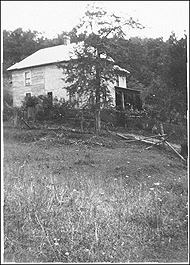
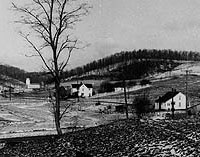
house sat on a small piece of land, which was surrounded by fields
and woods owned by two farmers. Up the valley we could see the
farmhouse and farm of Aunt Lillie and the farm and house of another
farmer. In other directions, three tenant houses and another farmhouse
were in sight. The farmhouses were like ours, white clapboard,
two story, eight to ten rooms. Each had its barns and outbuildings.
The tenant houses were smaller, usually painted, with a few outbuildings
for storage.
The
man at my house, my father, left early each morning to go to whatever
building he was doing. He returned in time for supper. The men
in all the farm houses were up before my father, out calling the
cows in summer or wading the snow to get to the various barns
to feed and tend to cattle, sheep, hogs and horses in winter.
They returned to their houses on a regular schedule for breakfast,
dinner, and supper. The in-between hours were spent out in the
fields or among the barns. Aunt Lillie might see Uncle Charlie
when he came in to call for help with some broken farm equipment
or when he stopped by the kitchen to say he had to go to town
for some necessary supply, but most of the time, the house was
as much hers all day long as was the house that my Mother lived
in.
Likewise, for my Mother and Aunt Merica, for Aunt Lillie and all
the wives living in all these farm houses, the growing and preserving
of food, the managing of the meat and lard, the care of the chickens
and eggs was the work of women. My father was miles away building
a house and completely unavailable during the day. For men like
Uncle Charlie, farm work took precedence over any of the work
done at the house, so Uncle Charlie was unavailable.
Only
the plowing of the garden was a man's job. A farmer that Daddy
had hired would arrive at our garden with the horse and plow,
disk and harrow some day in early spring when he had time between
getting his own fields in order. It was always in time for the
earliest planting we wanted to do. Sometimes he laid off the garden;
sometimes that was left for Daddy to do. Uncle Charlie, like the
farmer who plowed for us, could work the plowing of the garden
in between his field work. Likewise, the farmer worked in running
the little plow through the garden when the young plants came
up. For this, if she got it, my mother had to wait until my father
got in from work and had had his supper. Other than this help,
the planting, the hoeing, the harvesting, and the preserving of
food was all women's work. The women provided the food the year
round.
Seeds
for the planting were those collected in the fall from selected
plants in the garden or seed bought from the seed catalogues or
from the hardware store in town. Our collected seeds and remaining
seeds in opened, bought packets were stored in the beehive shaped
old basket in the little safe in the dining room, the one with
the blue painted, punched tin front.
Aunt Merica managed the seeds. She selected the plant in the garden
that would be allowed to go to seed and tied it with a cloth string.
Then, in the fall, when the seeds were just ready to burst from
their casings, she broke it down over paper or an old cloth, shook
it hard, gathered up the corners of her container and carried
the seeds to the back porch where she spread them out on old plates
to fully dry before storing them in little paper packages in the
beehive basket. The best, the most tasty tomatoes got put in old
tea cups on the top of the stone wall, in front of the window
inside the cellar. There they sat and rotted away until Aunt Merica
decided the seeds were ready to be washed and dried. Beans, corn,
squash, pumpkin, rutabagas, everything got saved. Sometimes, when
the crop of the summer did not produce well, they would say that
they guessed the seed had run out; new seed would have to be bought
or we would swap something with the neighbors.
1|
2 | 3
| 4 | 5